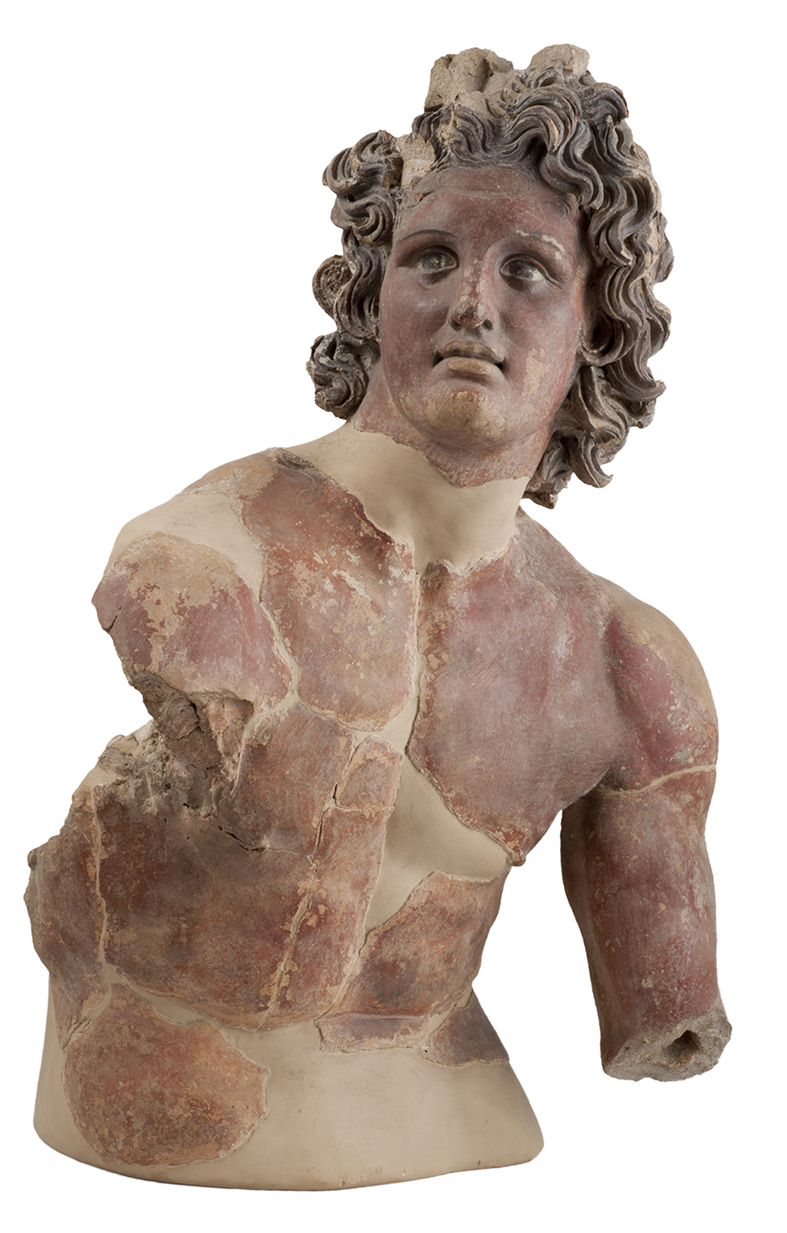
Busto of Apollo from the pediment of the Scasato I temple (4th cent. B.C.)
It is a hand-modelled, painted terracotta high relief, discovered around 1888. Only the upper part of the figure survives, having been reassembled from several fragments: the torso, shoulders, and head remain, while the lower body and parts of the arms are lost. Approximately two-thirds life-size, the figure was originally depicted seated, with its head turned to the right.
Apollo appears serene and idealised, with a high forehead, straight nose, full lips, and eyes that still preserve traces of their original colour. His face and body were painted dark red, following a figurative convention reserved for male figures. His dark-painted hair falls in large wavy locks around the face.
The bust of Apollo bears witness to the artist's direct relationship with the great Greek sculpture of the 4th century BC, particularly the models of Lysippus, Skopas, and Praxiteles. Through the hairstyle, the turning of the head, and the upward gaze, the image of the god evokes the so-called Alexander–Helios type of Lysippus, a famous portrait in which Alexander the Great is represented as the Sun god.