Questo sito o gli strumenti terzi da questo utilizzati si avvalgono di cookie necessari al funzionamento del sito. Chiudendo questo banner, scorrendo questa pagina, cliccando su un link o proseguendo la navigazione in altra maniera, acconsenti all'uso dei cookie.

ok, ho capito

JEWELRY FROM THE CASTELLANI COLLECTION

Multisensory itinerary


Video guide (Italian Sign Language) - Textual analisys (EN)

VIDEO GUIDE

Italian Sign Language

IN-DEPT ANALISYS

The Castellani workshop in a historic photo

The Castellani workshop in a historic photo

The main activity of the Castellani family was goldsmithing and jewellery making. The history of their workshop (1814–1927), located from 1869 in Piazza Trevi and widely visited by the European aristocracy of the period, was closely connected with their passion for collecting and dealing in antiquities. This interest played an important role in their work as jewellers.
Their creations were strongly inspired by ancient jewellery and reinterpreted in a modern way through the recovery of techniques, materials and artistic languages from Etruscan, Greek and Roman traditions, as well as Late Antique, Medieval and Renaissance productions.

Gold necklace (19th cent.) with silver coins (4th-3rd cent. a.C.)

Gold necklace (19th cent.) with silver coins (4th-3rd cent. a.C.)

On the tactile table, four jewels from the Castellani collection are presented to show the relationship between the study of antiquity, technical experimentation and artistic creation that characterised their workshop.
The gold necklace with silver coins from Magna Graecia and Corinth (4th–3rd century BC) shows a type of jewellery that became especially popular in the 19th century. Ancient coins, which at that time were relatively easy to obtain, were used to enrich modern jewels and were mounted in the same way as precious stones. In this example, coins with heads of deities are arranged symmetrically and in decreasing order from the central element (a Corinthian drachma dated 400–375 BC), showing Athena on the front and Pegasus on the reverse.

Gold pendant featuring the head of Achelous (19th cent.)

Gold pendant featuring the head of Achelous (19th cent.)

Another important example is the necklace pendant with the head of Achelous, created by the Castellani workshop starting from a Greek original of the 5th century BC that belonged to another collector of the time, Marquis Giampietro Campana (1808–1880).
This jewel represents one of the most refined results of the workshop’s experiments and stands out for the exceptional quality of its fine granulation technique. This method consists of applying extremely small gold granules to create surfaces rich in detail and light effects.

To recover this ancient technique, Alessandro Castellani dedicated many years to the direct observation of archaeological jewellery and to experimenting with gold-working methods, transforming knowledge of the ancient world into a new form of artistic creation.

The gold brooch with a lion and two ducks, inspired by an Etruscan fibula of the 6th century BC, shows instead the use of repoussé.

Gold brooch with a lion and two ducks (19th cent.)

Gold brooch with a lion and two ducks (19th cent.)

This technique consists of shaping thin sheets of metal (gold, silver or bronze) from the reverse side in order to create relief decoration on the visible side. Etruscan goldsmiths often combined this method with granulation and filigree to produce jewellery that was light but extremely rich in decoration: an effect that the Castellani successfully recreated in their 19th-century reinterpretations.

Alongside research into goldsmith techniques, the workshop also brought back the use of micromosaic to decorate their jewellery. Unlike granulation, which came from the rediscovery of Etruscan techniques, micromosaic revived a Roman figurative tradition. Made of tiny glass tesserae mounted on gold structures, it was widely used to communicate symbols, inscriptions and images inspired by Early Christian and Byzantine art.

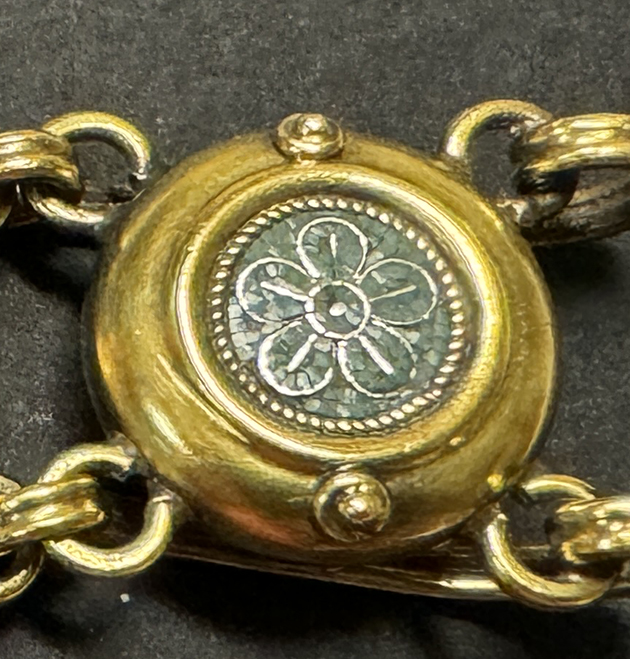
Gold and micromosaic bracelet element (19th cent.)

Gold and micromosaic bracelet element (19th cent.)

The bracelet shown on the tactile table, designed with two sides and decorated with gold on one side and micromosaic on the other, is also a “speaking jewel”, where words and images become an essential part of the object. On the micromosaic side appears the motto NON RELINQUAM (“I will not abandon you”), while on the opposite side appears NON RELINQUES (“You will not abandon me”): a symbolic dialogue that transforms the jewel into a mutual declaration of connection and loyalty. The final element of the bracelet includes a small flower in micromosaic and, on the gold side, the raised mark of the workshop formed by two letter C’s. This refers both to the Castellani family and to Michelangelo Caetani (1804–1882), Duke of Sermoneta and Prince of Teano, who worked closely with the workshop and created designs for many jewels, especially the so-called “speaking jewels”.

Thanks also to this collaboration, from the 1850s onwards the workshop introduced mottos in Greek, Latin and Italian on a regular basis, transforming jewellery into a message to wear.
Through the dialogue between collecting, archaeological research and artisanal experimentation, the Castellani workshop helped create a new way of looking at the past: not as a model simply to copy, but as a heritage to understand, reinterpret and pass on.

List of topics


Share on
facebook twitter
let's talk

Do you want to speak to us?

Send us your questions or follow us
facebook
instagram
twitter
youtube

Follow us on our social

newsletter

Subscribe to our newsletter

Contact us

Write to us.
Discover who we are and what we do.