Questo sito o gli strumenti terzi da questo utilizzati si avvalgono di cookie necessari al funzionamento del sito. Chiudendo questo banner, scorrendo questa pagina, cliccando su un link o proseguendo la navigazione in altra maniera, acconsenti all'uso dei cookie.

ok, ho capito

TOMBA FRANÇOIS

Multisensory itinerary


Video guide (IT) - Textual insight (EN)

VIDEO GUIDE

Italian Sign Language

BOX VIDEO 

List of the insights

Vulci Archeological Park

Veduta del Parco archeologico di Vulci

Veduta del Parco archeologico di Vulci

The François Tomb was discovered in 1857 by the Florentine archaeologist Alessandro François in the necropolis of Ponte Rotto in Vulci, in the province of Viterbo. The scholar had excavations carried out, and after four weeks of work found the entrance to a large tomb, never violated before. When he went in, he was left speechless. The walls were covered in marvellous paintings. In his letter to the scholars of the time he wrote that they were "so beautiful as to call to mind the finest days of Botticelli and Perugino" — an extraordinary comparison, which tells us how vivid and powerful those images were even after centuries.


ETRU image

The underground tomb carved into the tufa dates to the 4th century BC and belonged to the aristocratic family of the Saties.
On the left side of the table the floor plan of the tomb is represented: a long corridor leads to a large central atrium from which the funerary chambers branch off, inside which are the benches where the deceased members of the family were laid, and the tablinium, that is the main room of the tomb, symbolically corresponding to the bedroom of the deceased. It reproduces, in funerary architecture, the most important space of the Etruscan house, the one reserved for the head of the family. It is here that the body of the deceased was placed, often on a kline (funerary bed) carved into the rock, surrounded by personal belongings and funerary goods. The walls of the atrium and the tablinium were decorated with frescoes, among the most important in ancient Etruria, in which one can recognise, in the upper register, a decorative frieze with real and fantastical animals, while below, in the large figurative scenes, episodes and symbolic evocations are told, linked to the glorious past of the city, its present, and figures connected to Greek myth.
 

At the centre of the table three high-relief scenes are depicted, which have been chosen as the most significant within the tomb and are located on the right side of the atrium, where the frescoes of the Etruscan tradition are housed: 

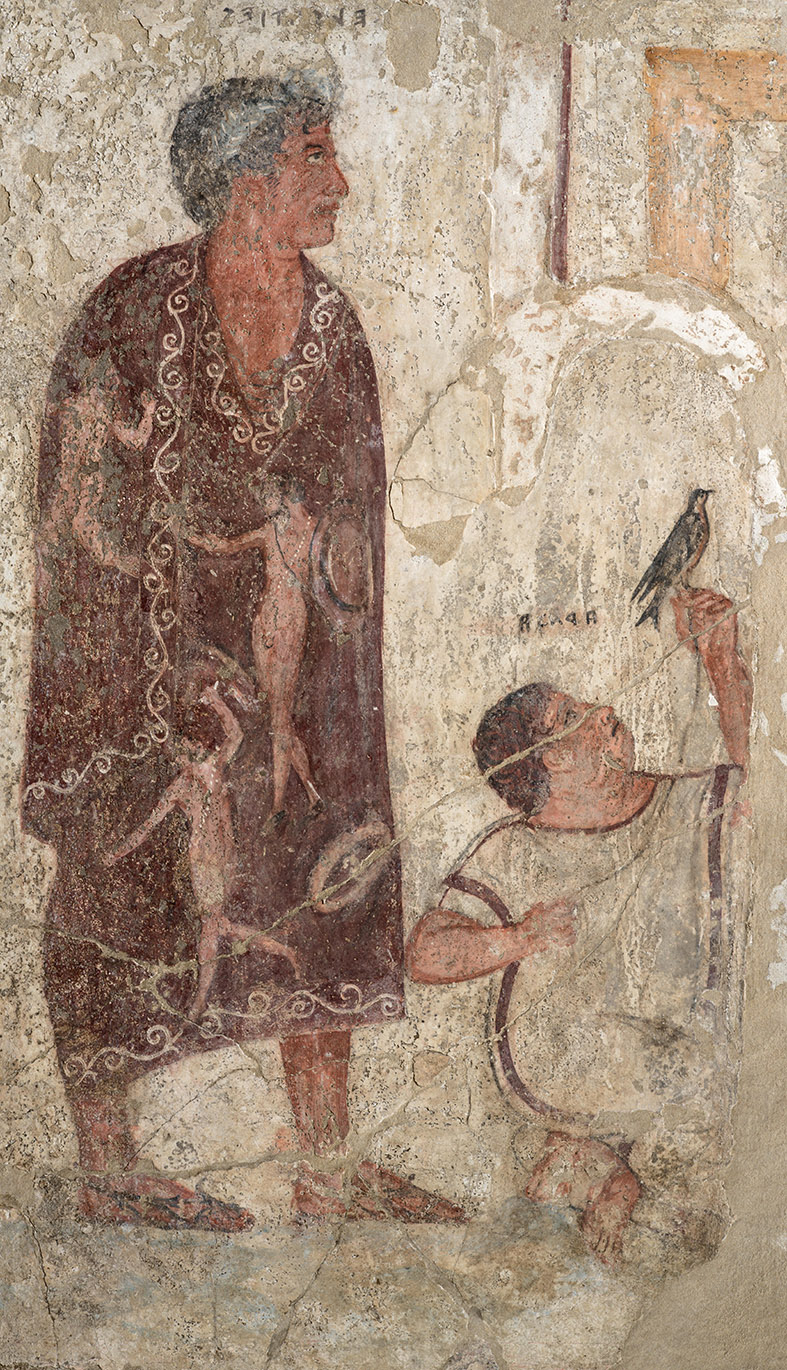
1. The first bas-relief portrays Vel Saties, owner of the tomb, depicted in profile, wrapped in the toga picta, that is a red cloak bordered with scrolls, a symbol of the highest social rank. Beside him, the young Arnza holds a bird in his hand, which some scholars have identified perhaps as a woodpecker, a bird sacred to many peoples of pre-Roman Italy, as a prophetic animal and symbol of strength and protection. The scene, given the type of clothing worn by the head of the family, in addition to documenting the aristocratic rank of the family, represents a true ritual, in which the master of the tomb scrutinises the future through sacred signs.

Celio Vibenna

Celio Vibenna

2. The second bas-relief depicts the central scene of the liberation of Caeles Vibenna by Mastarna. At the centre of the composition are the two figures: Caeles Vibenna (Caile Vipinas), bearded and naked, with his wrists still bound and his feet in the stocks, and beside him Mastarna (Macstrna), who according to tradition would later have reigned in Rome under the name of Servius Tullius, the sixth king of Rome, who cuts his bonds with a sword. The scene tells the story of an alliance between Etruscan warriors, of their struggle against Rome, and of the deep bond between Vulci and the origins of Italian history.

3. The third bas-relief, below, represents the most dramatic scene: the sacrifice of a Trojan prisoner. At the centre of the composition is Achilles, and beside him two figures from the world of the dead: Vanth, a winged goddess with her wings spread, and Charun, the blue demon guardian of the underworld, with his hammer. Before Achilles, seated on the ground, the first Trojan prisoner tilts his head backwards, upwards, as if to meet the gaze of his killer. For the Etruscans, the sacrifice of Achilles was the symbol of the bond between victory in war and the duty towards the dead, between the world of the living and that of the afterlife. Vanth and Charun are not figures of terror, but of cosmic order: they attend the death to ensure that everything takes place according to the laws of the universe.

Touch the fragment of tufa on the table beside the QR-code and discover tufa, the volcanic material with a porous texture, easy to work, with excellent insulating properties and of several varieties: in Etruscan tombs in the Latium area, peperino or nenfro — compact and resistant — were predominantly used.

Charun

Charun

The lightbox on the right side of the table reproduces the outline of the most enigmatic figure in the scene of the sacrifice of the Trojan prisoner: it is the figure of Charun (Xaru), the Etruscan guardian of the underworld — quite different from the Greek Charon. Charun has a greyish-blue complexion, a hooked nose, equine ears and a long hammer in his hand. He is not the ferryman of souls: he is the custodian of the threshold of Hades, the infernal presence that watches over the boundary between the world of the living and that of the dead. His blue colour is not a painterly defect: it is the colour with which death and the underworld were identified.

The François Tomb is far more than a tomb. It is a rare and precious testimony to how the Etruscans conceived of death, memory and family identity. Through its frescoes, we can read names, recognise faces, follow the thread of myths shared with the Greek and Roman world and reinterpreted in an Etruscan key. It tells of a people who believed in life and in the afterlife, and who chose painting as a form of commemoration. The Etruscans left us all of this, hidden in the tufa of Vulci. And we, even today, can appreciate it — and through it, draw closer to a civilisation that too often remains in the shadows, despite the depth and beauty of what it has left us.

List of the insights


Share on
facebook twitter
let's talk

Do you want to speak to us?

Send us your questions or follow us
facebook
instagram
twitter
youtube

Follow us on our social

newsletter

Subscribe to our newsletter

Contact us

Write to us.
Discover who we are and what we do.