Questo sito o gli strumenti terzi da questo utilizzati si avvalgono di cookie necessari al funzionamento del sito. Chiudendo questo banner, scorrendo questa pagina, cliccando su un link o proseguendo la navigazione in altra maniera, acconsenti all'uso dei cookie.

ok, ho capito

CASTELLANI VESSELS COLLECTION

Multisensory itinerary


Video guide (Italian Sign Language) - Textual insight (EN)

VIDEO GUIDE

Italian Sign Language

IN-DEPT ANALISYS

Fortunato Pio and Augusto Castellani

Fortunato Pio and Augusto Castellani

The Castellani Collection takes its name from a family of goldsmiths and collectors active in Rome throughout the 19th century. The first workshop was opened in 1814 by Fortunato Pio (1794–1865) in Via del Corso. His sons, Augusto (1829–1914) and Alessandro (1823–1883), also developed a strong interest in collecting and in the antiquities market. Alessandro became especially known as an international dealer and collector, while Augusto imagined the collections as a heritage to preserve and make accessible to the public.

In 1919, the last heir, Alfredo (1856–1930), donated the collection to the Italian State. The collection, made mainly of ceramics, bronzes and jewellery, has since been displayed in the rooms of Villa Giulia.

Pithos from Cerveteri, 6th cent. B.C.

Pithos from Cerveteri, 6th cent. B.C.

The main group of ancient vases in the Castellani Collection was formed mainly between 1860 and 1870 and includes objects dated from the 8th century BC to the Roman period.
The vases come from different areas — central and southern Italy, Greece, the Near East and North Africa — and reflect the great cultural variety of the ancient Mediterranean world. They are displayed according to period, place of origin and type, allowing visitors to observe the development of shapes, decorations and ceramic use over the centuries.
Greek and Etruscan vases are the most numerous. Among the Greek examples, Athenian productions are the most common and include works attributed to famous ancient painters such as Exekias, Oltos and the Berlin Painter. Many of the Etruscan vases instead come from workshops in Cerveteri.
A large part of the pottery was used for preparing and drinking wine, an important element of everyday life in the ancient world. Other vessels were intended for storing supplies and for body care.
The panel allows visitors to explore some of the main vase shapes and understand their function: each type of vase had a specific use.

The illustrated forms are: the krater, used to mix wine and water; the kantharos and the kylix, cups for drinking wine; the skyphos, a deep cup for drinking; the oinochoe, used to pour wine; the lekythos and the aryballos, containers for perfumes and oils; the Nicosthenic amphora, a special vessel connected with the Etruscan wine tradition; and the pithos, a large container for storing food supplies.
These vases were mainly made of terracotta, one of the most widely used materials in antiquity. Visitors can touch the material on the tactile table.

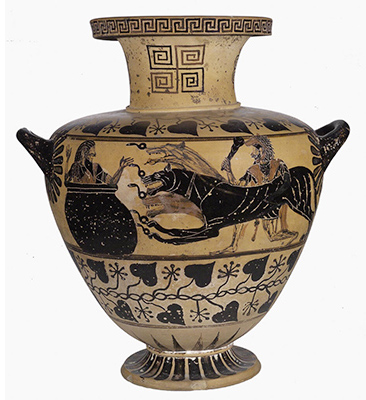
Hidrya with Heracles and Cerberus in front to  King Eurystheus, 530 B.C.

Hidrya with Heracles and Cerberus in front to King Eurystheus, 530 B.C.

Ancient vases were not only everyday objects: through their images they told stories about myths, beliefs and moments of daily life.

One of the most commonly used vessels was the hydria, designed for collecting and pouring water. In the centre of the panel, a relief reproduction shows the scene painted on the body of the Castellani Hydria, dated to the 6th century BC. The image represents the final moment of the twelfth and last labour of Heracles: the hero has captured Cerberus, the fierce three-headed dog guarding the Underworld, and brings him before King Eurystheus, who is terrified and hides inside a large pithos.

Through works like this, the Castellani Collection shows not only the beauty of ancient ceramics, but also the way images and objects accompanied everyday life in the societies of the ancient Mediterranean world.

List of topics


Share on
facebook twitter
let's talk

Do you want to speak to us?

Send us your questions or follow us
facebook
instagram
twitter
youtube

Follow us on our social

newsletter

Subscribe to our newsletter

Contact us

Write to us.
Discover who we are and what we do.